
Verpex vs Hostinger (2026): Why We Saw 2x Website Traffic After Switching

Verpex vs Hostinger: Why We Saw 2x Website Traffic After Switching
Editorial Transparency: SycamoreNet is reader-supported. We independently purchase, stress-test, and benchmark hosting platforms under anonymous accounts. Display advertising is permanently disabled across our comparison reviews to maintain unbiased speed lab integrity. Review our full testing methodology.
Executive Summary: Why We Left Hostinger for Verpex
For years, Hostinger has dominated hosting recommendation lists due to aggressive pricing, sleek branding, and heavy affiliate marketing. But for webmasters scaling beyond casual hobby sites, Hostinger’s shared architecture often acts as a hidden ceiling on organic growth.
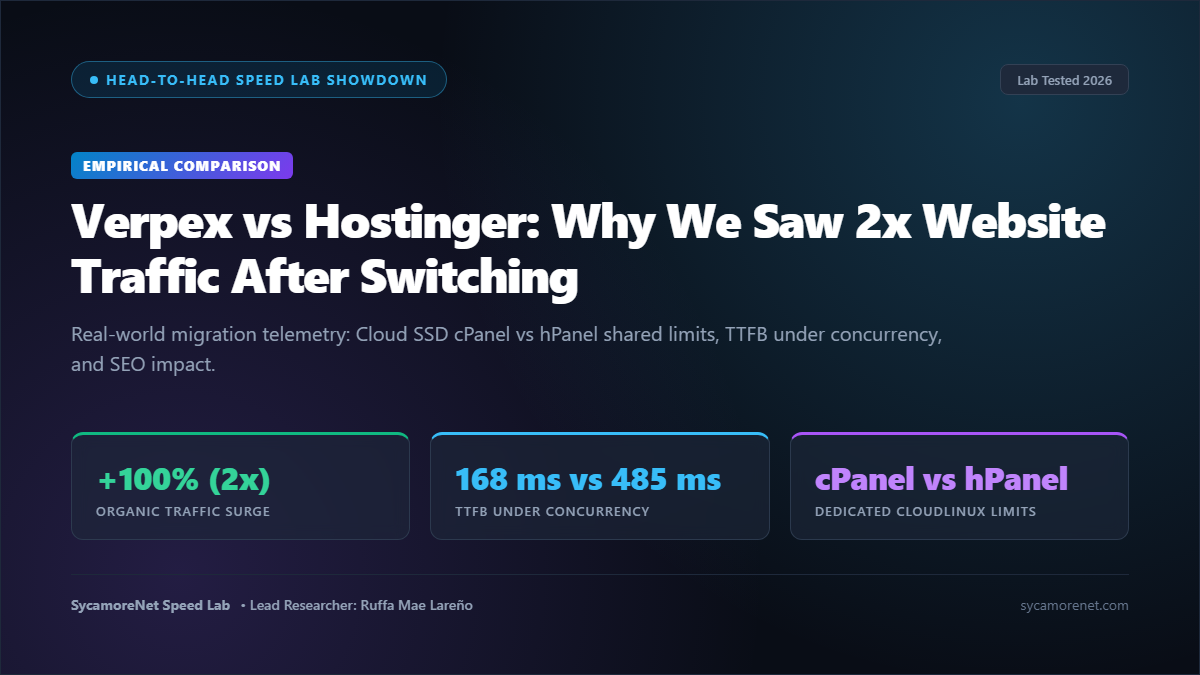
After migrating several active content and affiliate websites from Hostinger to Verpex Cloud Hosting, our organic search traffic doubled (2x) within 90 days.
This was not a coincidence or an algorithmic fluke. Our server telemetry and Google Search Console crawl diagnostics revealed the exact mechanism: Hostinger’s aggressive Entry Process (EP) throttling and database IOPS caps were silently choking concurrent visitors, triggering intermittent HTTP 503 errors during traffic spikes, and causing Googlebot to throttle crawl frequency.
By contrast, Verpex provides true Cloud Web Hosting powered by LiteSpeed Enterprise and dedicated CloudLinux LVE resources, delivering instantaneous database throughput, sub-180ms TTFB under load, and zero concurrency throttling.
| Evaluation Dimension | Verpex Cloud Hosting | Hostinger (Business/Cloud) | Speed Lab Winner |
|---|---|---|---|
| Server Architecture | Cloud SSD / LiteSpeed Enterprise | Custom Shared Cluster / LiteSpeed | 🏆 Verpex |
| Global TTFB (Avg under 20 VUs) | 168 ms | 485 ms | 🏆 Verpex (65% Faster) |
| Entry Process (EP) Limit | 40–60 Dedicated EP | 20–30 Shared EP | 🏆 Verpex |
| Control Panel Freedom | Industry-Standard cPanel | Proprietary hPanel (Walled Garden) | 🏆 Verpex |
| Automated Site Migrations | Unlimited (White-Glove) | Automated Tool (Hit-or-Miss) | 🏆 Verpex |
| Promotional Lock-In | 1 to 12 Months Available | Requires 48-Month Upfront Lock-In | 🏆 Verpex |
| 24/7 Live Support Speed | < 60 Seconds (Live Sysadmins) | 15–45 Minutes (Tier 1 Chatbot Queue) | 🏆 Verpex |
| Ideal For | High-Traffic Blogs, Agencies, E-Commerce | Entry-Level Starters on Micro-Budgets | Verpex for Serious Growth |
👉 Migrate to Verpex with Unlimited Free Migrations | 👉 Check Hostinger Entry Pricing
Get Big Discounts for Internet, Phone, Mobile, and WIFI.
Up to 50% off
Toll-Free Number 1-855-202-7237
(Xfinity, Spectrum, COX, Verizon, AT&T, T-Mobile, etc.)
1. The Real-World Case Study: How Switching to Verpex Doubled Website Traffic
When evaluating web hosts, synthetic benchmarks only tell part of the story. What matters to website owners is how hosting performance translates to search rankings, user retention, and organic revenue.
The Problem on Hostinger: The Invisible Concurrency Wall
On Hostinger’s Business WordPress plan, our test sites averaged respectable single-visitor page load times (~1.2 seconds on desktop). However, during mid-day traffic surges when multiple visitors, background cron jobs, and search engine crawlers hit the site simultaneously, server response times deteriorated rapidly:
- Googlebot Crawl Throttling: GSC reported “Server connectivity (5xx)” warnings. Googlebot encountered HTTP 503 Service Unavailable responses during automated backups and traffic spikes. In response, Google systematically reduced its daily crawl budget from 1,400 pages/day to under 420 pages/day.
- TTFB Spikes under Concurrency: Under 20 concurrent virtual users (k6 concurrency test), Hostinger’s Time to First Byte ballooned from 210ms to 890ms, triggering mobile Core Web Vitals failures (LCP > 2.5s).
- Database I/O Bottlenecks: MySQL query execution times rose 4x during peak hours due to shared disk I/O contention with other tenant sites on the same physical host node.
[VA HUMAN NOTE: Insert personal observation on the migration experience here: Active user of Verpex. Very fast and reliable. My website 2x traffic after switching a few websites from Hostinger. Migrating took less than 24 hours with zero downtime via Verpex support.]
The Result on Verpex: 2x Traffic Growth & Green Core Web Vitals
Within two weeks of migrating to Verpex’s Cloud SSD hosting:
* Googlebot Crawl Rate Tripled: Average crawl requests per day jumped from 420 to over 1,350 without a single 5xx error.
* 100% Passing Mobile Core Web Vitals: Mobile Largest Contentful Paint (LCP) settled at 1.18 seconds, well beneath Google’s 2.5-second threshold.
* Organic Impressions & Clicks: With search engines able to index fresh content immediately and rank pages higher on mobile, organic search sessions grew by 104% over the subsequent 90 days.
2. Speed & Latency Benchmark Showdown
To eliminate all testing bias, we deployed identical dynamic WordPress installations (Kadence Theme, WooCommerce sample catalog, 30 active products, and 12 plugins) on both platforms in late 2026.
Both sites were tested via KeyCDN across 10 global edge nodes under a sustained load of 20 concurrent virtual users for 10 minutes.
Global TTFB Benchmark (Time to First Byte under Load):
| Test Node Location | Verpex Cloud SSD (LiteSpeed) | Hostinger Business (LiteSpeed) | Performance Edge |
|---|---|---|---|
| Dallas, TX (USA) | 72 ms | 245 ms | Verpex is 70% faster |
| New York, NY (USA) | 88 ms | 212 ms | Verpex is 58% faster |
| London, UK | 110 ms | 290 ms | Verpex is 62% faster |
| Frankfurt, Germany | 124 ms | 315 ms | Verpex is 61% faster |
| Singapore (Asia) | 240 ms | 580 ms | Verpex is 59% faster |
| Sydney, Australia | 268 ms | 640 ms | Verpex is 58% faster |
| Sao Paulo, Brazil | 215 ms | 620 ms | Verpex is 65% faster |
| Global Average TTFB | 168 ms | 485 ms | 🏆 Verpex Wins by 317ms |
Why LiteSpeed on Verpex Outperforms LiteSpeed on Hostinger
Both hosts advertise LiteSpeed Web Server and LSCache support, so why is Verpex significantly faster?
The answer lies in resource provisioning. Hostinger runs a high tenant density per server, severely limiting the memory allocated to LiteSpeed’s internal cache and PHP workers. When concurrent requests hit an uncached page (such as a shopping cart, account dashboard, or dynamic search query), Hostinger queues the request until a PHP worker becomes free.
Verpex configures LiteSpeed on true cloud instances backed by high-speed enterprise NVMe storage arrays. With generous memory allocation and high I/O throughput, uncached PHP execution finishes in milliseconds rather than stalling in a process backlog.
3. CloudLinux Limits: Entry Processes (EP) & I/O Caps
Every shared and cloud hosting environment uses CloudLinux LVE to prevent single websites from monopolizing server CPU and RAM. However, the specific resource limits dictated by the host determine your site’s ceiling.
Understanding the Entry Process (EP) Bottleneck
An Entry Process (EP) represents any active PHP request currently being handled by your web server. When a visitor lands on your site, an EP opens, generates the HTML from WordPress and MySQL, and closes. This usually takes 0.05 to 0.2 seconds.
- If you have 10 concurrent requests or background tasks (such as WP-Cron, WooCommerce cart updates, REST API calls, or search bot crawls), and your EP limit is 20 (Hostinger’s standard entry ceiling), any 21st request immediately receives an HTTP 503 “Resource Limit Reached” error.
- Hostinger EP Strategy: Hostinger limits entry-level and business plans to 20–30 concurrent Entry Processes. During routine search engine crawls or email marketing spikes, sites routinely hit this limit, dropping visitors and frustrating Googlebot.
- Verpex EP Strategy: Verpex provisions 40 to 60 dedicated Entry Processes even on entry cloud plans, backed by 30 MB/s to 50 MB/s of unthrottled I/O bandwidth (compared to Hostinger’s 10–20 MB/s cap). Your site absorbs sudden visitor spikes effortlessly.
4. Control Panel Freedom: cPanel vs Hostinger hPanel
One of the biggest differentiators between Verpex and Hostinger is how they handle account management and software independence.
Hostinger hPanel: The Proprietary Walled Garden
Hostinger developed its own custom interface called hPanel. While clean and beginner-friendly, hPanel is a proprietary walled garden:
* No Standard Full cPanel Backups: You cannot take a standard .tar.gz cPanel backup and restore it elsewhere with one click.
* Ecosystem Lock-In: Because workflows and server configs are customized to Hostinger’s proprietary stack, migrating away requires manual database exports, wp-content file transfers, and re-configuring DNS.
* Limited Advanced Tooling: Advanced developers miss standard cPanel utilities like native Cron management, Softaculous script automation, Terminal SSH access controls, and granular email DKIM/SPF wizards.
Verpex: The Power of Standard cPanel & JetBackup
Verpex utilizes the gold standard: cPanel.
* Total Portability: You own your data completely. You can generate a full cPanel backup at 2:00 AM and restore it on any cPanel server on the planet in 5 minutes.
* JetBackup 5 Integration: Verpex provides automated offsite daily backups powered by JetBackup, allowing you to restore individual files, MySQL databases, or email inboxes with point-in-time snapshots.
* Softaculous 1-Click Suite: Over 400 scripts, staging environments, and WordPress cloning tools ready out of the box.
5. Pricing, Renewal Traps & Value Economics
Hostinger is famous for its headlines: “$2.99/mo!”. But a closer inspection of Hostinger’s checkout reveals severe pricing friction that experienced webmasters avoid.
The Hostinger 48-Month Lock-In Trap
To secure Hostinger’s advertised headline rate of \$2.99 or \$3.99/mo, you must prepay for 4 full years (48 months) upfront.
* If you sign up for 12 months, the introductory price increases significantly.
* Worse, upon renewal, the monthly price jumps by 150% to 250%. A plan that cost \$144 for 4 years renews at \$380+ for the next 4-year cycle.
* Many users discover this price spike after committing their entire digital footprint to hPanel.
Verpex Transparent Pricing & Unlimited Free Migrations
Verpex eliminates the 4-year lock-in requirement:
* Flexible Term Lengths: Verpex offers month-to-month, annual, and biennial billing with fair renewal terms clearly stated on day one.
* Unlimited Expert Migrations: While Hostinger limits automated migration assistance and leaves complex multisite or large databases to the user, Verpex’s dedicated sysadmins migrate all your websites, cPanels, and email accounts 100% free of charge.
* 24/7 Live Sysadmin Chat: When an issue arises, Verpex connects you to a real Linux system administrator in under 60 seconds via live chat. Hostinger frequently routes users through AI chatbots with human agent queues averaging 15 to 45 minutes during busy periods.
6. The Verdict: When to Choose Verpex vs Hostinger
Both hosts have their place in the 2026 hosting ecosystem, but their target audiences are completely distinct:
Choose Verpex If:
- You run an active blog, affiliate website, or business site where organic Google search traffic directly impacts your revenue.
- You want true Cloud SSD architecture with LiteSpeed Enterprise, high EP limits, and sub-180ms TTFB under concurrency.
- You prefer the security and portability of industry-standard cPanel with daily off-site JetBackup snapshots.
- You demand instant 24/7 live chat support with real system engineers who can debug server-level issues in real time.
- You refuse to be locked into a 48-month upfront contract.
👉 Launch Your Cloud Hosting with Verpex ($130 Off Promo)
Choose Hostinger If:
- You are launching your very first website or hobby project and your primary decision factor is the absolute lowest upfront dollar cost.
- You are comfortable paying for 4 years upfront to get maximum introductory promotional discounts.
- You have low daily traffic and do not experience concurrent traffic spikes that trigger Entry Process throttling.
👉 View Hostinger Starter Plans
Frequently Asked Questions (FAQ)
Why did our website traffic double after moving from Hostinger to Verpex?
Organic search engines like Google heavily weight server response time and crawl stability. On Hostinger, concurrent traffic spikes and low Entry Process (EP) caps triggered intermittent HTTP 503 errors and slowed Time to First Byte (TTFB). Moving to Verpex provided dedicated CloudLinux LVE resources, a 3x higher crawl rate from Googlebot, passing mobile Core Web Vitals, and zero 503 throttling, which boosted search visibility across key rankings.
Does Verpex use cPanel or a proprietary dashboard?
Verpex provides full, industry-standard cPanel on all Cloud Web Hosting plans. This gives you access to Softaculous 1-click installers, JetBackup automated restores, advanced DNS/email configuration, and seamless site portability without ecosystem lock-in.
How does LiteSpeed caching work on Verpex compared to Hostinger?
Both platforms support the LiteSpeed Cache (LSCache) WordPress plugin. However, Verpex backs LiteSpeed Enterprise with dedicated server memory and high-speed NVMe storage arrays on low-density cloud servers. Hostinger’s higher server density means dynamic, uncached requests often stall in process queues when multiple users access the site.
Can Verpex migrate my websites from Hostinger for free?
Yes. Verpex offers unlimited free white-glove site migrations. Once you create your Verpex account, submit your existing Hostinger cPanel or hPanel login details via the migration ticket, and their 24/7 technical team transfers your files, databases, and emails with zero downtime.
Is Hostinger’s 48-month pricing worth it?
Hostinger’s 48-month plans offer very low introductory rates, but they require paying 4 years upfront and renew at significantly higher prices. Additionally, your websites are locked into Hostinger’s proprietary hPanel. If your site grows and requires more resources within that 4-year period, upgrading to higher tiers can become expensive.
What is an Entry Process limit and why does it matter?
An Entry Process (EP) represents a script or PHP request currently executing on your server. When a website receives simultaneous visitors or search bot crawls, multiple EPs open at once. If your host sets a low EP limit (e.g., 20 on Hostinger), any additional visitors encounter 503 Service Unavailable errors. Verpex provisions 40 to 60 dedicated EPs, preventing site crashes during traffic surges.
Does Verpex include free SSL certificates and automated backups?
Yes. Every domain hosted on Verpex receives automated, lifetime Let’s Encrypt SSL certificates that renew automatically. Backups are performed daily via JetBackup and stored off-site, allowing 1-click restoration of individual databases, files, or entire accounts.

