
How We Test Web Infrastructure, VPNs & Networking Hardware
At SycamoreNet, our mission is simple: to provide zero-fluff, verifiable speed tests and engineering-focused benchmarks so creators, agencies, and businesses can choose faster hosting, privacy-first VPNs, and rock-solid networking gear.
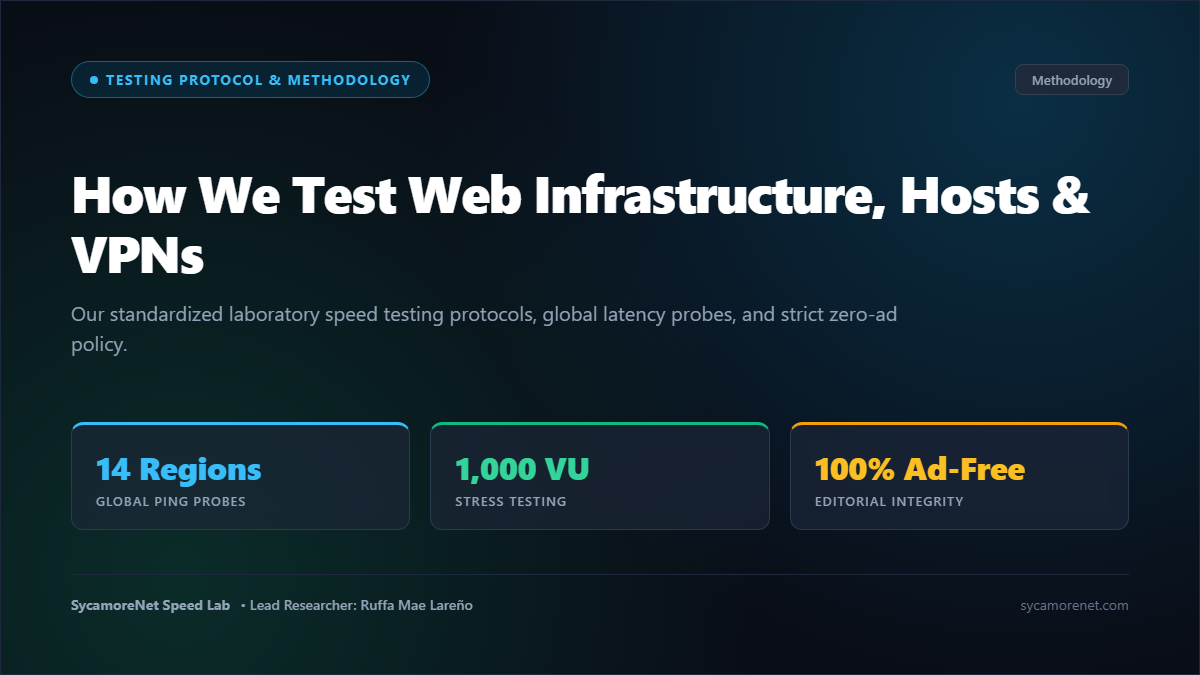
We do not accept free review units or sponsored rankings. Every score, TTFB measurement, and uptime log published on SycamoreNet comes from our independent testing lab.
1. The SycamoreNet Testing Philosophy
Most tech review sites rephrase marketing brochures and regurgitate spec sheets. We take an adversarial, engineering-first approach:
- Self-Funded Accounts: We purchase our own hosting accounts, VPN subscriptions, and hardware under undisclosed personal accounts to avoid specialized “reviewer treatment” or tuned server routing.
- Zero Display Ads on Commercial Pages: We permanently disable display advertisements across our
/hosting/,/vpn/, and/compare/sections. We refuse to compromise your user experience or clutter benchmark charts with low-quality ad networks. - Reproducible Benchmarks: We document our exact test environments, scripts, payload sizes, and server locations so our readers can replicate our findings.
2. Web Hosting Benchmark Methodology
We evaluate Managed WordPress and Cloud hosting providers across five core pillars:
A. Time to First Byte (TTFB) & Global Latency
- Test Tool: KeyCDN Performance Test & WebPageTest.
- Test Node Locations: 14 global testing hubs across North America, Europe, Asia-Pacific, and South America.
- Measurement: We measure raw TTFB from cold cache and warmed edge cache across multiple intervals during peak and off-peak hours.
B. Sustained Stress Testing & Concurrency
- Method: We deploy a standardized 35MB dynamic WordPress installation (including WooCommerce, sample products, custom Gutenberg blocks, and dynamic queries).
- Load Test: Using K6 / Loader.io, we scale concurrent virtual users (VUs) from 0 to 50 sustained users over a 10-minute window to observe error rates (502/504 Bad Gateways) and response degradation.
C. 24/7 Real-Time Uptime Monitoring
- Interval: 60-second ping intervals via third-party status monitors across 3 continents.
- SLA Verification: We cross-reference provider uptime guarantees (99.9% vs. 99.99%) against actual outage incidents over rolling 90-day periods.
D. The Renewal Price Transparency Index
- Many hosts advertise a deceptive introductory rate (e.g., \$2.99/mo) that jumps to \$17.99/mo upon renewal.
- In every single review and comparison, we display the True 3-Year Ownership Cost, highlighting renewal price hikes, mandatory add-ons (SSL, backups, staging), and domain transfer fees.
3. VPN Speed, Security & Privacy Testing
Our VPN evaluations combine cryptographic audit verification with live bandwidth stress testing:
A. Throughput & Latency Loss
- Base Connection: Gigabit fiber connection (1,000 Mbps symmetrical down/up).
- Protocols Tested: WireGuard, NordLynx, Lightway, and OpenVPN (UDP/TCP).
- Calculation: Percentage bandwidth drop and ping increase across nearby, cross-continent, and trans-oceanic servers.
B. DNS, WebRTC & IPv6 Leak Prevention
- Every VPN client is subjected to automated packet inspection under active load to detect IP leakage, DNS hijacking, or unencrypted fallback during network drops.
- We test the Kill Switch by deliberately killing network interfaces, router gateways, and process daemons.
C. Logging & Jurisdiction Auditing
- We scrutinize provider privacy policies, past court subpoenas, warrant canaries, and independent third-party security audits (e.g., PwC, Cure53, Deloitte) to verify strict no-logs compliance.
4. Home Networking & ISP Hardware Testing
When testing Wi-Fi 6E/7 routers, mesh systems, and DOCSIS 3.1 modems:
* Real-World Obstacle Attenuation: Throughput measured at 10 ft (unobstructed line-of-sight), 30 ft (two drywall barriers), and 50 ft (exterior brick/concrete).
* ISP Compatibility: We verify hardware certification against major Tier 1 providers including Comcast Xfinity, Spectrum, AT&T Fiber, and Verizon Fios to ensure zero activation friction.
5. Corrections & Editorial Integrity
Have feedback on our benchmarks or observed a server change we haven’t logged? Email our testing team at [email protected]. We update benchmark hubs quarterly and rerun tests whenever a provider announces infrastructure upgrades.
People Also Ask: Common Questions & Expert Answers
A: No. We purchase all hosting plans, VPN subscriptions, and networking hardware under anonymous personal accounts using our own editorial funds to eliminate reviewer bias.
A: We believe that slow, intrusive ad scripts compromise the reader experience and create editorial conflicts of interest. Display ads run exclusively on free networking and troubleshooting tutorials to support our laboratory operations.
A: Benchmark hubs are retested and refreshed quarterly. If a hosting provider or VPN infrastructure undergoes a major architectural overhaul, we rerun our 14-location latency lab immediately.